Journal Article
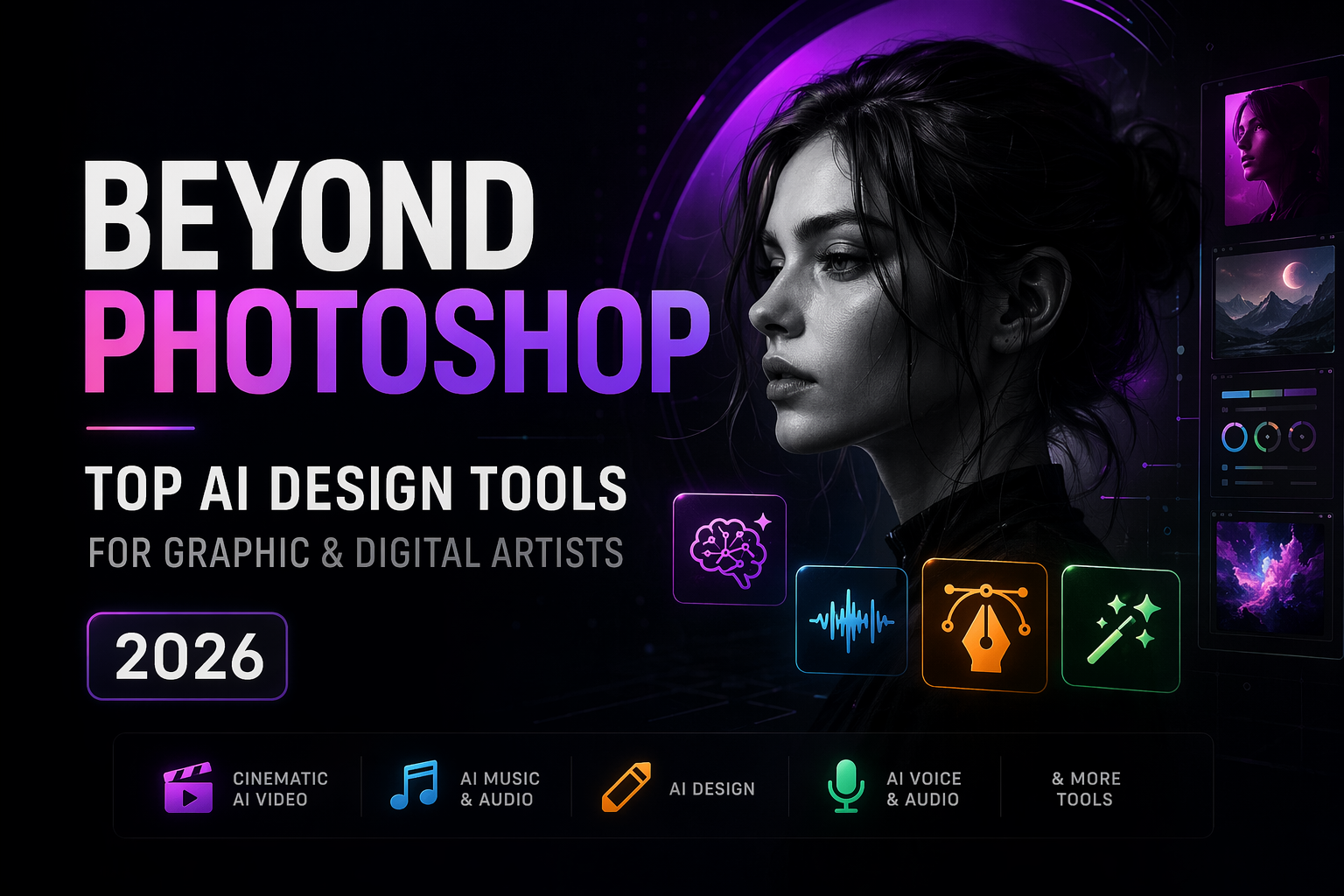
Beyond Photoshop: Top AI Design Tools for Graphic & Digital Artists (2026)
Discover the top AI design tools for graphic and digital artists in 2026, empowering creativity and streamlining workflows beyond traditional software like Photoshop.
Beyond Photoshop: Top AI Design Tools for Graphic & Digital Artists (2026)
The landscape of graphic and digital art is undergoing a profound transformation, and at its heart are sophisticated AI design tools. For decades, software like Photoshop reigned supreme, defining the boundaries of what was possible. But as we move deeper into 2026, artificial intelligence is not just enhancing existing workflows; it's fundamentally redefining the creative process, offering artists unprecedented power and efficiency.
Gone are the days when AI was a mere novelty. Today, these advanced platforms are becoming indispensable for graphic designers, illustrators, concept artists, and digital artists across the globe. They promise to automate the mundane, ignite new ideas, and push the very limits of visual storytelling, allowing creators to focus on the unique spark of their vision.
This article delves into the leading AI design tools available to graphic and digital artists in 2026. We’ll explore how AI empowers creativity, highlight essential tools for every creative project, uncover key features driving innovation, and discuss practical use cases that will boost your workflow. Get ready to discover how AI is moving us truly beyond Photoshop, ushering in a new era of artistic expression.
Redefining Design: How AI Empowers Creativity
Artificial intelligence isn't here to replace human creativity; it's here to supercharge it. For graphic and digital artists, AI acts as an invaluable creative partner, augmenting skills and streamlining processes that once consumed countless hours. This partnership allows artists to break through traditional limitations and explore new dimensions of design.
One of the most significant ways AI empowers creativity is by automating repetitive and time-consuming tasks. Imagine automatically removing backgrounds with pixel-perfect precision, upscaling low-resolution images without quality loss, or generating endless variations of a design concept in seconds. These capabilities free artists from the drudgery, allowing them to dedicate more time to conceptualization, refinement, and injecting their unique artistic voice.
Furthermore, AI design tools serve as powerful catalysts for inspiration. Faced with a creative block? AI can generate novel textures, color palettes, or visual motifs based on simple prompts or existing artwork, providing fresh starting points. This generative capability means artists can iterate faster, test more ideas, and arrive at innovative solutions that might have been unattainable through traditional methods. It democratizes complex techniques, making advanced visual effects and styles accessible to a broader range of artists. Effectively, AI helps in Overcoming Creative Blocks: How AI Solves Artists' Toughest Pain Points, allowing the human mind to focus on the truly creative aspects.
Essential AI Design Tools for Graphic & Digital Artists (2026)
The market for AI graphic design tools is rapidly expanding, offering a diverse array of solutions tailored to various artistic needs. From generating entirely new visuals to perfecting existing ones, these tools are becoming staples in the modern artist's toolkit. Understanding the categories and their potential is key to harnessing their power.
One of the most revolutionary categories includes AI image generation platforms. These tools allow artists to conjure images from text prompts, sketches, or even other images. Whether you need a realistic photograph of a fantastical creature, an abstract landscape, or a specific graphic element, these generators can produce high-quality assets in moments. They are particularly useful for concept art, mood boarding, and rapid prototyping, significantly accelerating the initial stages of any visual project.
Beyond generation, AI also excels in image manipulation and enhancement. Tools dedicated to smart upscaling can enlarge images multiple times their original size without pixelation, crucial for preparing digital art for print or high-resolution displays. AI-powered image editing features include automatic color correction, intelligent retouching, style transfer (applying the aesthetic of one image to another), and advanced object removal, all executed with a level of sophistication that was once the exclusive domain of expert human editors.
For those working with vectors, AI-driven vectorization tools can convert raster images into scalable vector graphics with impressive accuracy, saving countless hours of manual tracing. Other innovative tools assist in UI/UX design by suggesting layouts, generating design systems, or even building entire mockups from simple textual descriptions. To navigate this vast ocean of possibilities, curated resources like The Ultimate AI Tools Directory for Creators: Yasmaanik.art Curations can be incredibly valuable in finding the right solutions for your specific workflow.
Key Features: From Concept to Polished Masterpiece with AI
The power of digital art AI lies in its ability to offer features that not only automate but also elevate every stage of the design process. From initial conceptualization to final polish, AI tools provide capabilities that were once unimaginable or incredibly labor-intensive.
At the conceptual stage, text-to-image generation stands out. Artists can simply describe their vision—"a cyberpunk city at sunset, neon reflections, cinematic lighting"—and the AI generates multiple visual interpretations. This allows for rapid ideation and exploration of diverse aesthetic directions without lifting a digital pen. Complementing this is image-to-image transformation, where an artist's rough sketch or a low-fidelity image can be refined and stylized into a professional-grade artwork, maintaining the original composition but enhancing details and artistic flair.
For refinement, AI offers unparalleled precision. Automatic background removal tools can isolate subjects with surgical accuracy in seconds, far surpassing manual selection methods. Object manipulation goes further, allowing artists to effortlessly move, resize, or even generate new elements within an image, maintaining photorealistic blending and consistent lighting. Consider needing to add an extra character to a scene or change the pose of an existing one—AI can facilitate this with astonishing realism.
Beyond direct image changes, AI provides intelligent assistance in areas like color palette generation (suggesting harmonious schemes based on a mood or existing image), smart upscaling for printing high-resolution art, and even AI-powered brush engines that adapt to an artist's style or generate unique textures. These features combine to create an ecosystem where an artist's intent can be translated into a polished masterpiece with unprecedented speed and creative flexibility.
Boosting Your Workflow: Design Use Cases with AI
Integrating AI into your workflow isn't just about using fancy tools; it's about optimizing your entire creative process. For graphic and digital artists, AI offers practical, tangible benefits across a myriad of projects, from commercial assignments to personal art.
Consider logo design and branding. Instead of spending hours sketching countless iterations, AI can generate dozens of unique logo concepts, font pairings, and color schemes based on a brand brief. Artists can then select the most promising options and refine them, dramatically accelerating the initial ideation phase and providing clients with a broader range of choices.
For marketing visuals and social media content, AI is a game-changer. Artists can quickly create bespoke ad creatives, social media banners, and campaign imagery by generating scene variations, adjusting lighting, or personalizing content for different audience segments. This allows for rapid A/B testing and a constant flow of fresh, engaging visuals, critical in today's fast-paced digital environment.
In the realm of game art and concept design, AI empowers artists to produce vast libraries of assets. Imagine generating diverse environment textures, character variations, prop designs, or even entire conceptual scenes from simple inputs. This capability frees concept artists to explore grander visions and streamlines the asset creation pipeline for game developers. Similarly, AI can assist in web and UI design by generating icons, illustrations, or even entire layout sections based on design principles, allowing designers to focus on user experience. For those looking to fully embrace these new methodologies, Mastering AI-Powered Workflows: A Guide for Creative Professionals offers invaluable insights into integrating these tools seamlessly.
The Future Landscape: AI in Art and Design
As we look towards 2026 and beyond, the integration of AI into art and design workflows is only set to deepen, ushering in an era of unprecedented creative possibilities. The trajectory of AI development suggests a future where the boundary between human intention and machine execution becomes increasingly blurred, fostering entirely new forms of artistic expression.
One key trend is the rise of real-time AI collaboration. Imagine co-creating with an AI that understands your artistic style and preferences, generating elements or suggesting modifications instantly as you work. This could manifest as AI-powered design assistants that predict your next move, offering relevant assets or stylistic adjustments before you even ask. This fluid, intuitive partnership will accelerate the creative loop, allowing artists to bring complex visions to life with minimal friction.
We'll also see further advancements in hyper-personalization and adaptive design. AI will become adept at generating art that resonates deeply with specific audiences or individuals, creating dynamic visuals that react to user input, mood, or even biometric data. This opens up avenues for interactive art installations, personalized digital experiences, and marketing content that feels uniquely tailored. Furthermore, ethical considerations surrounding AI-generated art, ownership, and authenticity will continue to evolve, shaping best practices and legal frameworks. Delving into these broader impacts and potential evolutions is crucial for any creator, as explored in The Future of Creativity: AI Trends and Insights for 2026 and Beyond. The future promises not just tools, but intelligent companions that redefine the very essence of artistic creation.
Frequently Asked Questions: AI Design Tools
Is AI replacing graphic designers and artists?
No, AI is not replacing graphic designers and artists; it's augmenting their capabilities. AI automates mundane tasks, provides creative inspiration, and allows for rapid iteration, freeing artists to focus on higher-level conceptualization, emotional storytelling, and their unique artistic vision. It empowers them to do more, faster, and with greater innovation.
How can AI improve my design workflow?
AI can dramatically improve your design workflow by automating tasks like background removal, image upscaling, and object manipulation. It also offers powerful generative capabilities for quick concept creation, mood boarding, and generating variations, significantly reducing time spent on initial ideation and repetitive editing, allowing more focus on creative refinement.
Are AI-generated images truly original?
The originality of AI-generated images is a complex and evolving topic. While AI tools generate new visuals, they do so by learning from vast datasets of existing images. This raises questions about style influence and intellectual property. Many AI tools include features to ensure unique outputs, but artists are encouraged to add their creative input to ensure their work truly stands out and is legally sound. For more insights on the broader implications, see Frequently Asked Questions: AI Tools for Creators, Filmmakers & Musicians.
Do I need to be a coding expert to use AI design tools?
Absolutely not. The beauty of modern AI design tools is their user-friendliness. Most platforms are designed with intuitive graphical interfaces, often relying on simple text prompts, drag-and-drop functionalities, and visual controls. No coding expertise is required to leverage the powerful capabilities of these tools.
Conclusion
As we push beyond the traditional confines of software like Photoshop, AI design tools are emerging as the indispensable companions for every graphic and digital artist in 2026. They are not merely enhancements but transformative technologies that are redefining what's possible in visual creation. By automating the repetitive, inspiring the unexpected, and accelerating the iterative process, AI empowers artists to transcend their current limits and focus on the true essence of their craft: imagination and storytelling.
Embracing these advancements means unlocking unparalleled efficiency and boundless creative potential. The future of design is a collaborative dance between human intuition and artificial intelligence, resulting in masterpieces that are richer, more dynamic, and more impactful than ever before. It's an exciting time to be a creator.
Are you ready to explore this new frontier? Dive into the world of curated AI tools. Yasmaanik.art offers a handpicked selection designed to empower your creative journey, helping you discover and master the AI tools that will shape your artistic future. Yasmaanik.art: Your Curated AI Toolkit for Creative Exploration Explained.