Journal Article
Frequently Asked Questions: AI Tools for Creators, Filmmakers & Musicians
Demystify AI tools for creators, filmmakers, and musicians with our comprehensive FAQ. Get answers on cost, ethics, originality, and how to get started with AI, curated by Yasmaanik.art.
Frequently Asked Questions: AI Tools for Creators, Filmmakers & Musicians
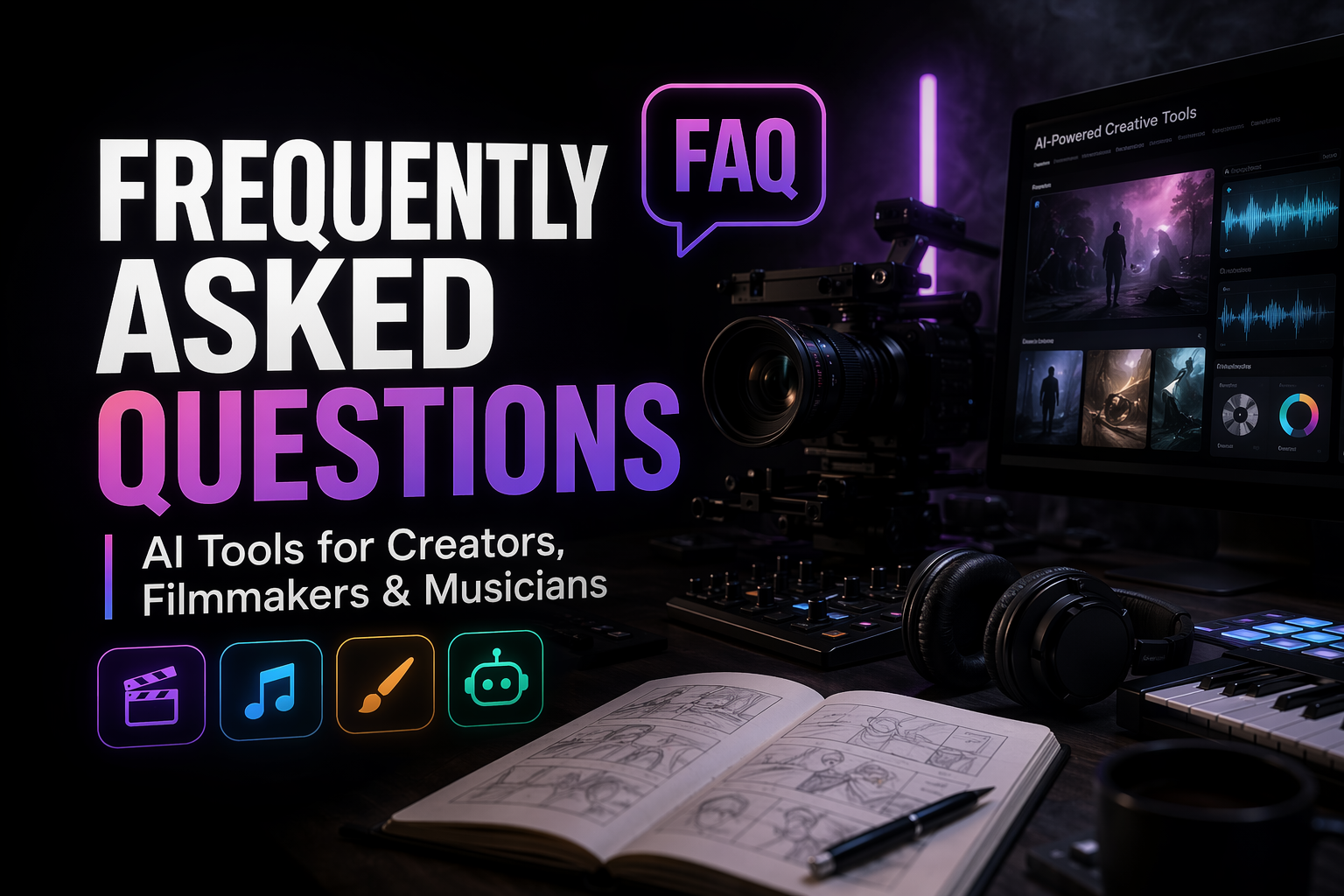
The world of creative AI tools is exploding, offering unprecedented opportunities for creators, filmmakers, and musicians. From generating stunning visuals and intricate soundscapes to automating tedious tasks, AI is reshaping how we approach art. However, with this rapid evolution comes a whirlwind of questions and sometimes, a little confusion. Many aspiring and established artists wonder: What exactly are these tools? How much do they cost? Is my art still original if AI is involved? And what about the ethical considerations?
At Yasmaanik.art, we're dedicated to helping you navigate this exciting frontier. We curate over 150 real AI tools across 12 categories, providing factual descriptions, pricing, key features, pros/cons, and use cases to empower your creative journey. This comprehensive FAQ aims to demystify AI tools for creators, filmmakers, and musicians, answering your most common questions and helping you confidently integrate AI into your workflow.
Whether you're a filmmaker exploring generative video, a musician experimenting with AI composition, a designer pushing the boundaries of digital art, or simply curious about getting started with AI, this guide is for you. We'll cut through the jargon, address the practicalities, tackle the ethical dilemmas, and cast an eye toward the future of creative AI. Let's embark on this enlightening journey together.
Demystifying AI: Your Top Questions Answered
Artificial intelligence might sound like something out of a sci-fi movie, but in the creative realm, it’s quickly becoming an indispensable partner. Understanding its fundamental role can alleviate common anxieties and unlock its full potential. Creators often seek clarity on what these tools actually do and how they fit into traditional artistic processes. This section breaks down the basics, ensuring you have a solid foundation for exploring the AI landscape.
What Exactly Are AI Tools for Creators?
AI tools for creators are software applications or platforms that use artificial intelligence algorithms to assist, enhance, or automate various stages of the creative process. These tools leverage machine learning to recognize patterns, generate new content, or interpret complex data in ways that would be time-consuming or impossible for humans alone. For example, AI can generate unique melodies, design elaborate visual textures, or even script entire scenes based on your input. They are designed to augment human skill, not replace it, offering a co-creative experience that pushes boundaries. Think of them as intelligent assistants, capable of handling specific tasks with speed and precision.
How Can AI Tools Enhance My Creative Process?
AI tools offer a multitude of enhancements. For filmmakers, AI can generate realistic visual effects, quickly animate characters, or even create rough cuts from raw footage. Master Cinematic AI: Top Tools & Apps for Next-Gen Filmmakers on Yasmaanik.art explores how these innovations are transforming the industry. Musicians can use AI to compose original scores, generate variations of existing themes, or master audio tracks with unprecedented efficiency. Designers benefit from AI tools that can generate unique textures, assist with logo design, or even optimize layouts for different platforms. Beyond direct creation, AI can automate repetitive tasks like data entry, asset organization, or routine editing, freeing up artists to focus on conceptualization and artistic direction. This newfound efficiency allows for more experimentation and iteration, leading to richer, more diverse creative outcomes.
Is AI Going to Replace Human Creativity?
This is perhaps the most common question, and the answer is a resounding "no." AI tools are powerful assistants, but they lack human intuition, emotional depth, lived experience, and the capacity for truly original, conceptual thought. They are excellent at pattern recognition and content generation based on existing data, but they don't feel or intend. Human creativity, with its nuanced storytelling, emotional resonance, and unique perspective, remains irreplaceable. Instead of replacement, consider AI as a sophisticated collaborator. It handles the heavy lifting, the iterative tasks, or generates inspiration, allowing the human creator to focus on vision, meaning, and the unique artistic voice. The most compelling works often emerge from a symbiotic relationship between human and AI, where each brings their unique strengths to the table.
Practicalities: Cost, Learning Curve & Technical Requirements
Venturing into the world of AI tools doesn't have to be daunting. Many creators are naturally concerned about the financial investment, the time commitment to learn new software, and whether their existing equipment can handle the demands. This section addresses these practical considerations head-on, providing clear expectations and guidance to help you make informed decisions about integrating AI into your workflow.
Are AI Tools Expensive, or Are There Free Options?
The cost of AI tools varies widely, ranging from completely free options to enterprise-level subscriptions. Many platforms offer freemium models, providing basic features for free and charging for advanced functionalities, higher usage limits, or commercial licenses. For instance, you can find excellent free AI tools for basic image editing, text generation, or sound manipulation. As your needs grow, you might explore subscription-based services that offer more powerful AI models, faster processing, and dedicated support. Yasmaanik.art extensively details pricing for each tool, so you can easily compare and find solutions that fit your budget. Don't let perceived cost be a barrier; there are fantastic resources available for every financial commitment.
How Steep is the Learning Curve for AI Creative Software?
The learning curve for AI creative software is generally becoming much flatter. Developers are prioritizing user-friendly interfaces and intuitive workflows, often resembling familiar creative applications. Many tools feature drag-and-drop functionality, natural language prompts (like simply typing what you want to create), and clear tutorials. While mastering advanced features will always require dedication, getting started with basic AI generation or enhancement can be surprisingly quick. Platforms like Yasmaanik.art provide detailed descriptions and use cases for each tool, helping you understand their core functionalities before you even download or subscribe. Our blog post Mastering AI-Powered Workflows: A Guide for Creative Professionals offers strategies for integrating these tools smoothly into your existing process.
What Hardware and Software Do I Need to Get Started?
For many cloud-based AI tools, you don't need a supercomputer. Most modern web browsers and a stable internet connection are sufficient, as the heavy processing often happens on the provider's servers. However, for more demanding applications, particularly those involving local processing of high-resolution video or complex 3D rendering, a more robust setup might be beneficial. This could include:
- Processor (CPU): A modern multi-core processor (Intel i7/i9 or AMD Ryzen 7/9 equivalent or better).
- Graphics Card (GPU): A dedicated graphics card with significant VRAM (e.g., NVIDIA RTX series or AMD Radeon RX series) is crucial for tasks like AI video generation or stable diffusion models.
- RAM: At least 16GB, with 32GB or more recommended for intensive tasks.
- Storage: Fast SSD storage is preferable for quick loading and saving of large project files.
Always check the specific system requirements for any AI tool you're considering. Many platforms offer tiered services based on your hardware capabilities, ensuring accessibility for a wide range of creators.
Creative & Ethical Concerns: Ownership, Originality & Bias
As AI tools become more integrated into creative workflows, important questions around ethics, ownership, and originality inevitably arise. These aren't just academic discussions; they have real-world implications for artists, their livelihoods, and the future of creative industries. Navigating these complex issues requires thoughtful consideration and an understanding of evolving legal and societal norms.
Who Owns AI-Generated Art and Content?
The question of ownership for AI-generated content is complex and rapidly evolving. Currently, intellectual property laws (like copyright) typically require a human author. This means that if an AI generates content entirely autonomously, without significant human creative input, it may not be eligible for copyright protection in some jurisdictions. However, if an artist uses AI as a tool to create a piece, providing substantial creative direction and modifications, then the human artist is generally considered the author and retains copyright. It's crucial to check the Terms of Service (ToS) for each AI tool you use, as they often outline specific clauses regarding ownership and commercial use of generated assets. The Ultimate AI Tools Directory for Creators: Yasmaanik.art Curations provides links to each tool, making it easier to review their terms. Always be informed about what you're agreeing to.
Is AI Art Truly Original, or Just a Copy?
The originality of AI art is a contentious topic. AI models are trained on vast datasets of existing human-created content. Therefore, their outputs are inherently derived from this training data. Some argue that this makes AI art inherently unoriginal, merely a sophisticated remix or pastiche. However, proponents contend that just as human artists draw inspiration from countless sources, AI can generate novel combinations and styles that are distinct enough to be considered original in their own right, especially when guided by a human's artistic vision. The key often lies in the "prompt engineering" and the subsequent human refinement. When an artist uses AI as a brush, guiding its output to manifest a unique vision, the result can be profoundly original. The debate continues, but it's clear that the human element of curation, selection, and modification plays a crucial role in establishing originality.
How Can We Address Bias in AI-Generated Outputs?
AI models learn from the data they're fed, and if that data contains biases (e.g., gender, racial, cultural stereotypes), the AI will inevitably reproduce and even amplify those biases in its outputs. This is a significant ethical concern, especially in creative fields where representation and authenticity are paramount. Addressing bias requires multi-faceted approaches:
- Diverse Training Data: Developers must prioritize training AI models on more diverse and inclusive datasets.
- Bias Detection Tools: Integrating tools that can identify and flag biased outputs.
- Human Oversight: Creators must critically evaluate AI-generated content for unintended biases and be prepared to refine or reject problematic outputs.
- Ethical AI Development: Encouraging transparency in AI model development and advocating for ethical guidelines across the industry.
Creators also have a role to play in consciously guiding AI outputs to challenge, rather than reinforce, existing biases. This conscious intervention is part of the art itself.
The Ethical Use of AI in Creative Fields
Beyond ownership and bias, the ethical landscape of AI in creative fields encompasses several other considerations. This includes transparency about AI's involvement in a work, especially if it's presented as purely human-made. There's also the question of fair compensation for artists whose work contributes to AI training data, and the potential impact on jobs in creative industries. As a creator, ethical use means:
- Transparency: Disclose when and how AI is used in your creative process, especially for commercial works.
- Respect for IP: Understand and respect the intellectual property rights associated with AI tools and their training data.
- Conscious Creation: Use AI to uplift, inspire, and create responsibly, avoiding misuse or the generation of harmful content.
The journey with AI is a shared one, and collective ethical responsibility will shape its future impact on art.
Future Outlook: What's Next for AI in the Creative World?
The pace of AI innovation is staggering, and what seems futuristic today quickly becomes commonplace tomorrow. Predicting the exact trajectory is challenging, but certain trends indicate an exciting, and increasingly intertwined, future for AI and creativity. This final section explores the evolving capabilities, the deepening human-AI collaboration, and the importance of continuous learning for creators.
Evolving Capabilities: What's on the Horizon?
Expect AI tools to become even more sophisticated and intuitive. We'll likely see:
- Hyper-realistic Generation: AI will produce even more indistinguishable video, audio, and imagery, blurring the lines between real and synthetic. Think advanced virtual sets for filmmakers or fully AI-composed and performed orchestral pieces for musicians.
- Multi-modal AI: Tools that seamlessly integrate text, image, video, and audio generation, allowing for complex, cohesive creative projects from a single prompt.
- Personalized AI Assistants: AI tailored to individual creators' styles, preferences, and historical work, acting as an even more intuitive extension of their artistic vision.
- Real-time Interaction: AI generative capabilities that respond instantly to a creator's actions, making co-creation feel more like a live jam session than a static generation process.
The Future of Creativity: AI Trends and Insights for 2026 and Beyond offers a deeper dive into these exciting developments.
The Human-AI Collaboration Paradigm
The future isn't about AI replacing humans, but rather about a more deeply integrated human-AI collaboration. This paradigm shift will see creators becoming "AI whisperers," masters of prompt engineering, and expert curators of AI-generated content. The focus will move from pixel-level manipulation to conceptual design, artistic direction, and the ethical stewardship of AI. Artists will learn to speak the language of AI, guiding its vast generative power to manifest their unique visions. This collaboration allows for unprecedented speed, scale, and experimentation, pushing the boundaries of what's creatively possible. It's an exciting time to be a creator, with an intelligent co-pilot ready to assist in every imaginative flight.
Staying Ahead: Continuous Learning in a Rapidly Changing Landscape
Given the rapid advancements, continuous learning is paramount for creators. Staying informed about new tools, ethical guidelines, and emerging techniques is no longer optional; it's essential. Engage with communities, follow AI research, and regularly experiment with new platforms. Yasmaanik.art's journal is specifically designed to keep you updated with insights and trends in art, tech, and generative creativity. By embracing a mindset of lifelong learning, creators can not only adapt but thrive in this dynamic new creative ecosystem, harnessing AI to amplify their unique artistic voice and push the boundaries of what's possible.
Conclusion
The journey into AI tools for creators, filmmakers, and musicians is filled with both immense potential and complex questions. We've explored the basics of what these tools are, how they can supercharge your creative process, and addressed common concerns about their cost, learning curve, and technical requirements. Crucially, we've delved into the profound ethical considerations surrounding ownership, originality, and bias, offering a framework for responsible and impactful AI integration.
The future of creativity is undoubtedly intertwined with AI. It's a future where human intuition and machine intelligence converge, opening doors to artistic expression we can only just begin to imagine. By understanding the answers to these frequently asked questions, you're better equipped to navigate this new landscape, turning challenges into opportunities and limitations into launchpads for innovation.
Don't just observe the revolution; be a part of it. Explore the curated selection of tools, deepen your understanding with our journal, and confidently step into the future of creative expression. Discover how AI can transform your artistic vision today. Explore the Yasmaanik.art directory now and find your next creative AI partner.