Journal Article
Mastering AI-Powered Workflows: A Guide for Creative Professionals
Unlock peak efficiency and creativity. Learn to master AI-powered workflows, seamlessly integrating intelligent tools into your creative process for filmmakers, designers, musicians, and artists.
Mastering AI-Powered Workflows: A Guide for Creative Professionals
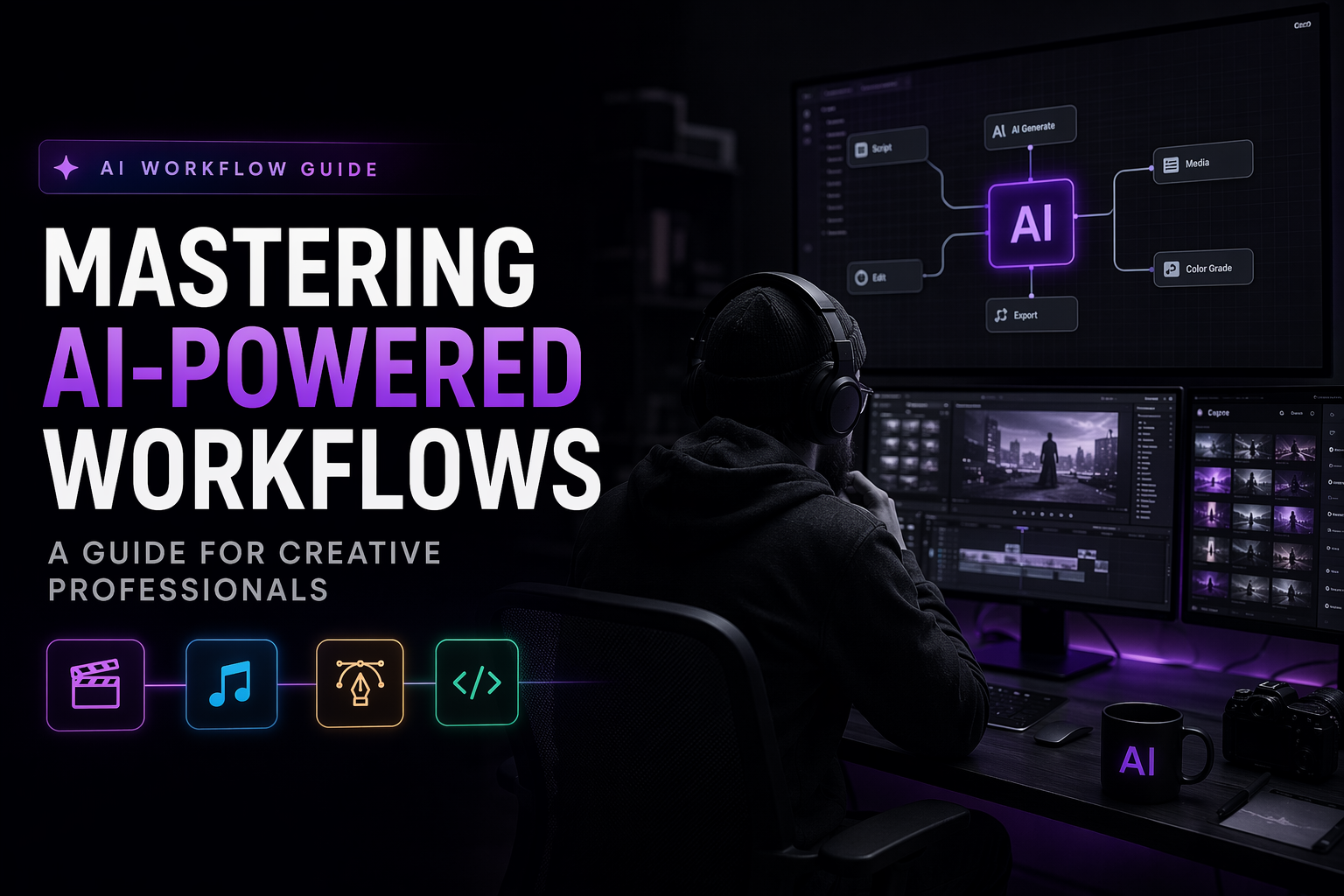
The creative landscape is shifting at an exhilarating pace, and at its heart lies the transformative power of Artificial Intelligence. For any creative professional—be it a filmmaker, musician, designer, or content creator—the ability to effectively integrate AI into daily operations is no longer a luxury but a crucial skill. Mastering AI-powered workflows means more than just using a new tool; it's about fundamentally rethinking how ideas are generated, developed, and brought to life.
This guide will demystify the process of optimizing your creative process with AI. We'll explore how to strategically choose and implement AI tools, ensuring they enhance rather than hinder your unique artistic vision. From initial concept to final distribution, we'll journey through the various stages where AI can become your most powerful creative partner, helping you achieve unprecedented efficiency and unlock new realms of artistic possibility. Join us as we navigate the exciting future of augmented creativity.
The Dawn of the AI-Augmented Creator: A New Paradigm
For decades, the creative process has been defined by human intuition, skill, and sheer effort. Now, AI presents a paradigm shift, introducing the concept of the AI-augmented creator. This isn't about replacing human artistry but rather enhancing it, amplifying our capabilities, and liberating us from repetitive tasks. The goal is to create a symbiotic relationship where human ingenuity directs and refines, while AI executes and explores.
Consider the filmmaker grappling with hours of footage, or the musician experimenting with countless sonic textures. AI can now provide intelligent assistance, accelerating tasks that once consumed valuable time and energy. This integration allows creative professionals to dedicate more energy to high-level strategic thinking, conceptual development, and the emotional core of their work, moving from being mere practitioners to visionary conductors of an advanced creative orchestra.
Shifting Perspectives: From Threat to Ally
Initially, many in the creative community viewed AI with skepticism or even apprehension, fearing it would devalue or automate their craft. However, a more nuanced understanding reveals AI as a powerful ally. Instead of seeing it as a competitor, we can embrace AI as a tireless assistant capable of generating variations, refining details, and providing data-driven insights. It's a partner that can handle the heavy lifting, allowing the human creator to focus on the unique spark that only they can provide. This shift in mindset is foundational to successfully mastering AI-powered workflows.
Identifying AI's Unique Strengths in Creativity
AI excels in areas where patterns, repetition, and rapid processing are key. For creators, this translates into several core strengths:
- Idea Generation & Brainstorming: AI can generate endless concepts, plot points, musical motifs, or design layouts, providing a vast pool of inspiration.
- Automation of Repetitive Tasks: From image upscaling to audio cleaning, content summarization to data organization, AI handles the mundane, freeing up mental bandwidth.
- Rapid Prototyping & Iteration: Quickly create multiple versions of a design, video sequence, or musical arrangement to explore different directions without significant time investment.
- Personalization & Optimization: AI can analyze audience preferences to tailor content, refine marketing messages, or even adapt a narrative for specific demographics.
- Accessibility & Democratization: Complex creative tasks can now be performed by a wider range of individuals, lowering the barrier to entry for aspiring artists.
Understanding these strengths is the first step toward strategically integrating AI into your unique creative process.
Designing Seamless Workflows: Best Practices for AI Integration
Integrating AI into your workflow isn't about haphazardly throwing tools at a problem; it requires thoughtful strategy and clear best practices. The objective is to create AI creative workflows that feel intuitive, efficient, and genuinely supportive of your artistic goals. This process involves careful tool selection, a structured approach to iteration, and a keen awareness of ethical considerations.
One of the best starting points for exploring the right tools is a curated resource like yasmaanik.art. Our platform offers a handpicked selection of AI tools, complete with factual descriptions and use cases, making it easier to discover the perfect fit for your specific creative needs.
Strategic Tool Selection for Your Creative Stack
The market for AI tools is exploding, making strategic selection paramount. Don't chase every new shiny object. Instead, focus on tools that directly address your pain points or significantly enhance a specific stage of your creative process.
- Identify Your Needs: What tasks are time-consuming? Where do you hit creative blocks? Which parts of your workflow could benefit from acceleration or new perspectives?
- Research & Compare: Dive into directories like yasmaanik.art to compare features, pricing, and user reviews. Look for tools designed for your specific creative niche – be it Cinematic AI filmmaking tools or AI music generators for artists.
- Test & Evaluate: Many tools offer free trials. Experiment to see how they integrate with your existing software and whether they truly deliver on their promises.
- Consider Scalability & Integration: Will the tool grow with your projects? Does it play well with other tools in your stack (APIs, file formats)?
By approaching tool selection with a clear strategy, you can build a powerful, cohesive AI-powered creative stack that truly helps in optimizing creative process AI.
Iteration & Feedback Loops with AI
AI thrives on iteration. Instead of expecting perfection from a single prompt, view AI as a rapid prototyping engine.
- Initial Generation: Provide a clear prompt to generate a first draft, concept, or asset.
- Human Review & Refinement: Critically evaluate the AI's output. What works? What needs adjustment? Where does your unique creative touch need to be applied?
- Refined Prompt/Input: Use your feedback to guide the AI for the next iteration. This might involve adjusting parameters, providing new examples, or explicitly correcting errors.
- Repeat: Continue this loop until the output meets your standards.
This collaborative approach ensures that the final product is a blend of AI efficiency and human artistic direction, producing results far beyond what either could achieve alone.
Data Privacy and Ethical Considerations
As creative professionals integrating AI tools, it's crucial to be mindful of data privacy and ethical implications.
- Input Data: Understand what data your AI tools use for training and whether your inputs become part of that training set. If working with sensitive or proprietary information, choose tools with robust privacy policies or local processing capabilities.
- Copyright & Ownership: Clarify the terms of service regarding ownership of AI-generated content. Who owns the copyright for an image, song, or script generated by an AI tool?
- Bias & Representation: Be aware that AI models can inherit biases from their training data. Critically review AI outputs for unintended stereotypes or misrepresentations, especially in content involving diverse subjects.
- Transparency: Clearly indicate when AI has been used in your work, especially if it's a significant component, to maintain transparency with your audience.
Addressing these points proactively ensures you build an ethical and sustainable AI-powered workflow.
From Concept to Distribution: Where AI Fits In
The beauty of integrating AI tools lies in their versatility across the entire creative lifecycle. From the first spark of an idea to the final push to your audience, AI can act as a force multiplier. Let's break down how AI can embed itself into each critical stage, transforming the way you work and helping you overcome common creative pain points.
For a deeper dive into how AI can tackle specific challenges, consider reading "Overcoming Creative Blocks: How AI Solves Artists' Toughest Pain Points."
Ideation & Pre-Production: Sparking Creativity
This is where the blank canvas can be most intimidating. AI can kickstart your imagination:
- Brainstorming & Concept Generation: Use AI writing tools to generate outlines for scripts, character backstories, song lyrics, or marketing taglines. Input a theme, and watch AI propose dozens of directions.
- Mood Boards & Visual References: AI image generators can quickly create visual mood boards based on textual descriptions, saving hours of searching for inspiration. Imagine an AI generating "noir sci-fi cityscapes with rain and neon" in seconds.
- Storyboarding & Animatics: For filmmakers, AI video tools can create rough animatics or visual storyboards from script inputs, helping visualize scenes before shooting.
Production & Creation: Enhancing the Craft
Once the initial ideas are solid, AI steps in to accelerate and enhance the actual creation:
- Content Drafting & Expansion: AI writing assistants can expand on outlines, generate blog posts, or draft social media captions, leaving you to refine the voice and message.
- Visual Asset Creation & Manipulation: AI design tools can generate unique graphics, upscale low-res images, remove backgrounds, or even create entirely new art styles. This is where tools from our "Beyond Photoshop: Top AI Design Tools for Graphic & Digital Artists (2026)" article truly shine.
- Audio Production & Sound Design: AI music generators can compose backing tracks, generate sound effects, or even master audio, while AI voice generators can create natural-sounding narration or character voices.
- Video Editing & Effects: AI-powered video editors can automate tasks like scene detection, color correction, and even generate complex visual effects, speeding up post-production significantly.
Post-Production & Distribution: Polishing and Reaching Audiences
The final stages benefit immensely from AI's precision and analytical power:
- Quality Control & Refinement: AI can identify errors in text, optimize image quality, or analyze audio for imperfections.
- Localization & Accessibility: AI translation tools can quickly localize content for global audiences, while AI can generate captions and transcripts, making your work more accessible.
- Marketing & Promotion: AI marketing tools can analyze audience data to identify optimal posting times, suggest engaging copy for social media, or even personalize ad campaigns.
- Analytics & Insights: AI can process vast amounts of performance data, helping you understand audience engagement, content effectiveness, and areas for improvement.
By weaving AI into each of these stages, creative professionals can achieve a level of output and efficiency previously unimaginable. For a comprehensive overview of how to integrate these intelligent tools, exploring "The Ultimate AI Tools Directory for Creators: Yasmaanik.art Curations" is an excellent next step.
Training & Adaptation: Evolving Your Skills with AI
The true mastery of AI creative workflows isn't just about knowing which tools to use; it's about evolving your own skillset to effectively collaborate with artificial intelligence. The landscape of creative work is changing, and staying ahead means embracing continuous learning and adaptation. As an AI-augmented creative professional, your role is more vital and complex than ever.
Becoming a "Prompt Engineer" and Beyond
One of the most talked-about new skills is "prompt engineering"—the art of crafting precise instructions for AI models to get the desired output. However, this is just the beginning. Your evolving skillset will also include:
- Critical Evaluation: AI generates, but you curate. Learning to discern high-quality, relevant, and original output from generic or flawed results is paramount.
- AI Model Understanding: Gaining a basic grasp of how different AI models work (e.g., generative adversarial networks, transformers) helps you anticipate their strengths and limitations.
- Iterative Design Thinking: AI thrives on feedback loops. Your ability to quickly analyze AI output, formulate constructive critiques, and adjust your input accordingly becomes a core competency.
- Ethical Oversight: As discussed, maintaining ethical standards and ensuring responsible use of AI falls squarely on the creative professional.
- Integration Specialist: Understanding how to connect various AI tools, use APIs, or script simple automations will make your workflow truly seamless.
These skills empower you to be not just a user, but a director of AI, guiding its capabilities toward your artistic vision.
Continuous Learning in a Rapidly Evolving Landscape
The pace of AI development is staggering. New models, tools, and techniques emerge almost daily. For the creative professional AI, continuous learning is essential:
- Stay Informed: Follow reputable AI news sources, research papers, and industry blogs. Platforms like the Yasmaanik.art Journal offer valuable insights and trends specifically for creators.
- Experiment Constantly: Dedicate time each week to trying new tools, experimenting with different prompting techniques, and pushing the boundaries of what AI can do.
- Join Communities: Engage with other AI-augmented creators. Share discoveries, troubleshoot challenges, and learn from collective experiences.
- Focus on Fundamentals: While tools change, core creative principles—storytelling, composition, emotion, audience engagement—remain constant. AI is a means to an end, not the end itself.
Embracing this journey of continuous adaptation ensures you remain at the cutting edge, leveraging AI to expand your creative horizons and maintain your competitive advantage. The future belongs to those who are willing to learn, adapt, and co-create with intelligent machines.
Frequently Asked Questions
Q: Will AI replace creative jobs?
A: AI is more likely to augment creative roles rather than replace them entirely. While AI can automate repetitive tasks and generate initial concepts, the unique human elements of empathy, critical judgment, nuanced storytelling, and emotional connection remain indispensable. Creative professionals who master AI integration will likely see their roles evolve, becoming more strategic and visionary.
Q: How do I choose the best AI tools for my specific needs?
A: Start by identifying your workflow bottlenecks or areas where you need creative assistance. Then, research tools specifically designed for those tasks (e.g., AI video generators for filmmakers, AI music generators for composers). Utilize curated directories like yasmaanik.art to compare features, pricing, and user reviews before testing tools with free trials.
Q: Is AI-generated content truly original?
A: The concept of "originality" with AI is complex. AI models generate content based on patterns learned from vast datasets, so elements might be reminiscent of existing work. However, the unique combination of prompts, parameters, and human refinement can lead to genuinely novel outputs. The creator's role in guiding, curating, and infusing their unique vision is what imbues AI-generated content with originality and artistic intent.
Q: How can I overcome the learning curve with new AI tools?
**A: **Start small. Focus on one or two key AI tools that address your most pressing needs. Utilize tutorials, documentation, and online communities for support. Experiment regularly and view errors as learning opportunities. Remember that many AI tools are designed for user-friendliness, and practice is key to developing intuition with prompting and refining outputs.
Conclusion
Mastering AI-powered workflows is not merely about adopting new technology; it's about embracing a new era of creative potential. For filmmakers, musicians, designers, and all creative professionals, AI offers an unparalleled opportunity to streamline processes, overcome creative blocks, and unlock imaginative avenues previously out of reach. By strategically integrating AI tools, you can amplify your unique vision, dedicate more time to core artistic endeavors, and ultimately produce work that is both more efficient and more impactful.
The journey to effective AI integration is ongoing, requiring continuous learning and a willingness to experiment. However, the rewards are immense: enhanced productivity, expanded creative horizons, and a deeper connection to your artistic purpose. Embrace the AI-augmented future, and discover how these intelligent partners can elevate your craft. Start exploring the possibilities today by diving into the curated resources and insights available on Yasmaanik.art, your ultimate guide to creative AI.