
Journal Article
Overcoming Creative Blocks: How AI Solves Artists' Toughest Pain Points
Feeling stuck? Discover how AI solves common creative pain points for artists, filmmakers, and musicians, streamlining your process and sparking new ideas. Unleash your potential with smart AI solutions.
Overcoming Creative Blocks: How AI Solves Artists' Toughest Pain Points
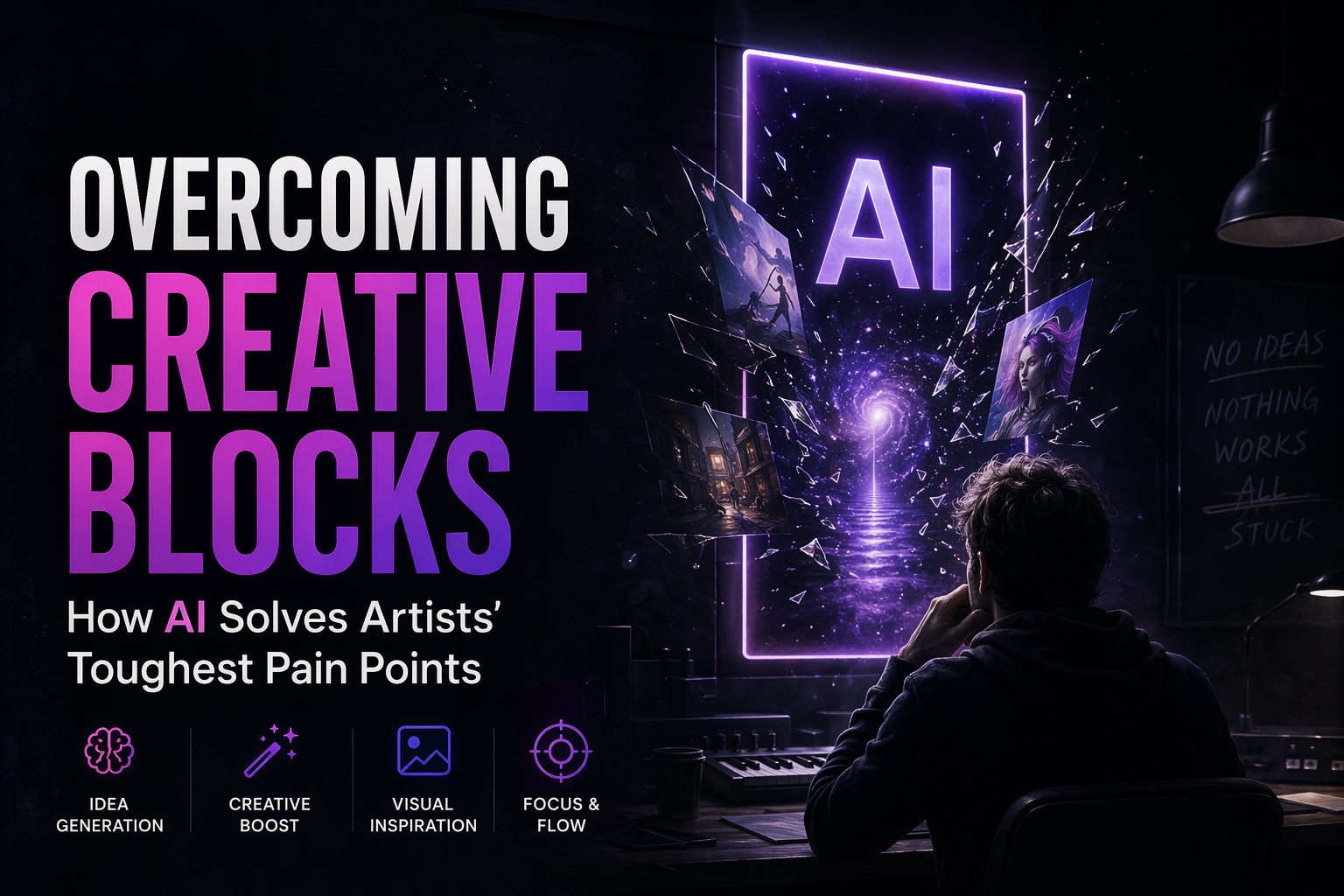
Every artist, filmmaker, musician, and content creator knows the feeling: the blank page, the stale melody, the uninspired shot. These creative pain points can be frustrating, leading to burnout and stalled projects. But what if there was a powerful partner to help navigate these challenges? Enter Artificial Intelligence. AI isn't here to replace human ingenuity, but to augment it, offering innovative solutions to the persistent dilemmas that plague the creative mind.
In this article, we'll dive deep into the most common struggles faced by creators and reveal how cutting-edge AI tools can turn these roadblocks into springboards for innovation. From sparking initial ideas to streamlining tedious post-production, AI is transforming the creative landscape, empowering artists to achieve more with less friction. Prepare to discover how these intelligent assistants can help you reclaim the joy of creation and push the boundaries of your artistic expression.
The Creator's Struggle: Common Hurdles in the Creative Process
The journey of creation is rarely a straight line. It's often punctuated by moments of doubt, frustration, and sheer exhaustion. Understanding these common creative pain points is the first step toward finding effective solutions. For artists, these struggles manifest in various forms, impacting productivity, inspiration, and overall well-being.
The Blank Canvas Syndrome
Perhaps the most notorious creative block is the "blank canvas" or "writer's block." Staring at an empty document, an untextured 3D model, or a silent DAW can be paralyzing. The pressure to generate original ideas, especially under deadlines, often leads to mental fatigue rather than breakthrough concepts. This isn't just about lack of inspiration; it's about the sheer overwhelming nature of infinite possibilities.
Repetitive and Tedious Tasks
Creative work, despite its glamorous facade, involves a significant amount of grunt work. For filmmakers, this might be rotoscoping, color grading consistency, or repetitive video editing. Musicians might spend hours on manual audio clean-up or layering. Designers often wrestle with resizing assets, cutting out backgrounds, or generating endless variations. These tasks are essential but consume valuable time and energy that could be better spent on conceptualizing and refining.
Technical Limitations and Skill Gaps
Not every creative is a master of every tool. A brilliant storyteller might struggle with advanced animation software, or a talented composer might lack the technical skills for complex sound design. Learning new software or acquiring niche skills takes time and resources, often becoming a barrier to fully realizing a vision. The fear of technical hurdles can stifle experimentation and limit the scope of projects.
Finding Fresh Inspiration
Even the most prolific creators experience periods of creative drought. Relying solely on personal experiences or traditional sources of inspiration can lead to repetitive themes or unoriginal outputs. The need to constantly innovate and stand out in a crowded digital world adds immense pressure, making it harder to consistently tap into novel ideas and perspectives.
AI as Your Creative Partner: Smart Solutions to Big Problems
Thankfully, the rise of AI tools offers powerful antidotes to these long-standing creative challenges. Instead of viewing AI as a competitor, envision it as an intelligent assistant, ready to shoulder the burdens of the mundane and spark unexpected avenues of thought. The integration of AI into your workflow isn't just about efficiency; it's about expanding your creative potential. For a deep dive into specific tools, explore The Ultimate AI Tools Directory for Creators: Yasmaanik.art Curations.
Breaking the Block with Idea Generation
AI excels at processing vast amounts of information and identifying patterns, making it an incredible brainstorming partner. AI writing assistants can generate countless variations of headlines, story outlines, or even complete scripts based on simple prompts. Image generation AI can conjure visual concepts from text descriptions, providing a jumping-off point for graphic designers and visual artists. Musicians can use AI to generate melodic motifs or chord progressions, sparking new compositions. This ability to rapidly produce diverse ideas helps creators overcome the initial paralysis and find a direction.
Automating the Monotonous
One of AI's most significant contributions to the creative process is its capacity for automation. AI-powered video editing software can automatically detect and cut scenes, apply consistent color grades, and even remove unwanted objects from footage. In audio, AI can denoise tracks, master mixes, and even separate stems with unprecedented accuracy. For designers, AI tools automate background removal, upscaling images, and generating design variations at scale. This frees up countless hours, allowing artists to focus on the nuanced, human-centric aspects of their craft. For filmmakers looking to streamline, check out Master Cinematic AI: Top Tools & Apps for Next-Gen Filmmakers on Yasmaanik.art.
Bridging Technical Skill Gaps
AI democratizes complex creative processes by abstracting away the underlying technical intricacies. Need a photorealistic 3D render but lack Maya expertise? AI can generate one from a text prompt. Want a professional voiceover but can't afford a studio? AI voice generators offer high-quality synthetic voices. This means creators are no longer limited by their individual technical proficiencies. They can leverage AI to perform tasks that once required specialized training, expanding their creative toolkit without extensive learning curves.
Igniting Fresh Perspectives
When inspiration dwindles, AI can act as a muse from an alternative dimension. AI art generators can create unique styles or blend existing ones in novel ways, providing visual artists with unexpected prompts. AI music composers can experiment with genres and harmonies that might be outside a human composer's typical range. Furthermore, AI research tools can rapidly analyze trends, identify gaps in content, or unearth obscure historical data, feeding creators with novel insights for their projects. By introducing unpredictable elements and vast datasets, AI encourages creators to think outside their established comfort zones.
From Idea Generation to Final Output: AI's Impact Across the Creative Workflow
AI isn't just a point solution for a single problem; it's an integrated partner throughout the entire creative lifecycle. From the moment an idea sparks to the final polished product ready for distribution, AI tools offer capabilities that enhance every stage.
Conception and Brainstorming
The very genesis of a project can be accelerated and enriched by AI. Instead of struggling with a blank page, creators can use AI prompt generators to explore themes, characters, plot points, or visual styles. For instance, an AI writing tool can offer 20 different story openings for a fantasy novel, or an AI image generator can provide visual mood boards for a film concept. This rapid ideation ensures that the initial creative phase is dynamic and expansive, reducing the "fear of the first step."
Prototyping and Draft Creation
Once a core idea is in place, AI helps translate it into tangible form quickly. Designers can use AI to generate multiple logo concepts or UI layouts. Filmmakers can create rough AI-generated video drafts from text, experimenting with different scenes and aesthetics before committing to complex production. Musicians can use AI to lay down foundational tracks, automatically generating drums, basslines, or orchestral arrangements. These AI-powered prototypes allow for iterative design and rapid feedback, dramatically shortening the time from concept to a workable draft.
Refinement and Optimization
The polishing phase, often the most time-consuming, also benefits immensely from AI. In video production, AI can assist with advanced color correction, stabilize shaky footage, or even upskill lower-resolution assets. For audio, AI mastering tools ensure consistent sound quality, while AI-powered mixing plugins can balance instruments automatically. Graphic designers use AI for intelligent upscaling, retouching, and generating variations for different platforms. AI also plays a crucial role in content optimization, suggesting keyword improvements for written content or analyzing audience engagement data for visual media.
Distribution and Marketing
Even after the creative work is complete, AI continues to assist by amplifying its reach. AI marketing tools can help creators identify target audiences, generate compelling ad copy, and schedule social media posts for optimal engagement. AI-driven analytics provide insights into content performance, helping artists understand what resonates with their audience and how to better promote their next masterpiece. This end-to-end integration ensures that the creative effort is not only high-quality but also effectively shared with the world. You can learn more about how AI can help you reach your audience in Amplify Your Reach: Best AI Marketing Tools for Artists & Creators (2026).
Reclaiming Joy in Creation: A Future with AI Assistance
The ultimate promise of AI in the creative sphere isn't just about efficiency or technical prowess; it's about reigniting the pure joy of creation. By offloading repetitive tasks and overcoming persistent blocks, AI allows artists to dedicate more time and energy to what they truly love: the conceptualization, the experimentation, and the emotional expression at the heart of their work.
Imagine a world where the drudgery of data entry or manual editing is a thing of the past. A world where inspiration is always a prompt away, and technical limitations no longer hold back ambitious visions. This is the future AI offers to creators. It's a future where artists are empowered to be more experimental, more prolific, and ultimately, more fulfilled. Yasmaanik.art is dedicated to curating the tools that make this future a reality, helping you navigate the evolving landscape of art and technology. Dive into our insights and trends on Yasmaanik.art Journal: Insights & Trends in Art, Tech, and Generative Creativity.
Frequently Asked Questions
Q1: Can AI truly understand creativity or only mimic it?
A1: While AI can generate novel combinations and outputs that appear creative, its "understanding" is fundamentally different from human consciousness. AI mimics creativity by identifying patterns and generating variations based on vast datasets. It acts as a powerful tool to assist human creativity, not replicate its consciousness.
Q2: Will AI replace human artists and creators?
A2: It's highly unlikely AI will replace human artists. Instead, it's transforming the definition of artistry. AI can handle tedious tasks and generate initial concepts, allowing human creators to focus on higher-level conceptualization, emotional depth, unique vision, and ethical decision-making that AI cannot currently replicate. AI will be a collaborator, not a replacement.
Q3: How can I start incorporating AI tools into my creative workflow without being overwhelmed?
A3: Start small! Identify one specific pain point you consistently face (e.g., idea generation, background removal, basic audio clean-up) and find an AI tool designed for that. Experiment with free trials. As you get comfortable, gradually integrate more tools. Resources like Yasmaanik.art: Your Curated AI Toolkit for Creative Exploration Explained are designed to help you discover and understand these tools.
Q4: Are AI-generated outputs truly original?
A4: The "originality" of AI outputs is a complex and evolving ethical discussion. AI generates content based on patterns learned from its training data. While the specific output might be unique, it is derived from existing works. Human curation, intervention, and artistic direction are crucial in transforming AI-generated elements into truly original and meaningful works.
Conclusion
The creative journey is inherently challenging, filled with moments of intense inspiration and frustrating stagnation. However, with the advent of AI, creators now have an unprecedented opportunity to mitigate their toughest pain points. From sparking initial ideas and automating repetitive tasks to bridging technical skill gaps and discovering fresh perspectives, AI acts as a sophisticated partner, amplifying human potential rather than diminishing it.
Embracing AI isn't about surrendering artistic control; it's about empowering yourself with tools that streamline your process, free up your time, and expand the horizons of what's possible. By leveraging these intelligent assistants, artists, filmmakers, and musicians can overcome creative blocks more effectively, reclaim the joy of hands-on creation, and focus on delivering the unique vision that only they can bring to life. Explore the curated world of AI tools on Yasmaanik.art today and transform your creative workflow.