Journal Article
AI Tools for Creative Coding: Bridging Art and Technology (2026)
Explore the cutting-edge synergy of AI and creative coding with 2026's top tools. Unleash generative art, interactive experiences, and dynamic visuals by bridging technology and artistic vision. Discover AI coding tools for creators today.
AI Tools for Creative Coding: Bridging Art and Technology (2026)
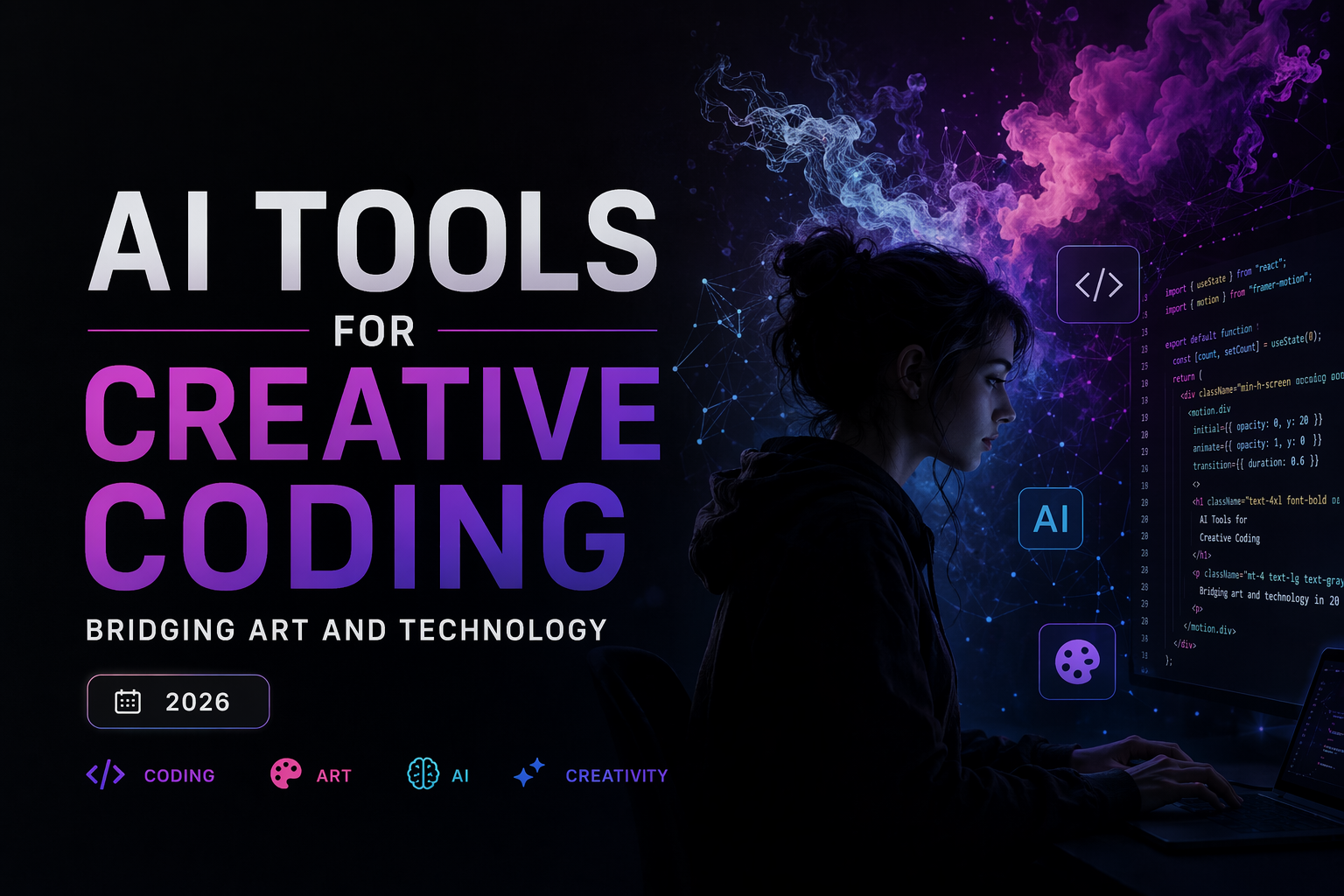
In the dynamic landscape of 2026, the lines between art, technology, and creation are not just blurring; they’re dissolving into a vibrant, interconnected realm. At the heart of this transformation lies AI tools for creative coding, empowering artists, designers, and innovators to push the boundaries of visual expression, interactive experiences, and generative art. No longer a niche discipline, creative coding, supercharged by artificial intelligence, is becoming a mainstream conduit for avant-garde projects.
This article delves into how AI is revolutionizing the creative coding space, offering unprecedented power to craft dynamic visuals, immersive installations, and intelligent interactive pieces. We'll explore the synergy that makes this possible, highlight the best creative coding AI tools available today, and ignite your imagination with inspiring projects. If you've ever dreamt of having your code come alive with an artistic consciousness, the future is now. Get ready to discover how generative art coding and AI art programming are shaping the next generation of digital masterpieces.
Code as Canvas: The Synergy of AI and Creative Coding
Creative coding, at its core, is the art of writing code not just for functionality, but for aesthetic exploration and expression. It’s about algorithms generating beauty, code creating interactive worlds, and logic unfolding into unexpected visual poetry. Traditionally, this involved intricate programming, deep mathematical understanding, and a keen artistic eye to manually craft patterns and behaviors.
Enter Artificial Intelligence. AI doesn't just automate; it augments. When paired with creative coding, AI becomes a powerful collaborator, capable of understanding stylistic nuances, generating complex patterns far beyond human capacity, and even responding intelligently to external stimuli. Imagine feeding an AI a dataset of historical art movements, then asking it to generate a new, never-before-seen style within a coded environment. This is the new frontier.
The synergy is profound: creative coders provide the algorithmic structure and conceptual framework, while AI fills in the details, explores vast parameter spaces, and introduces emergent properties that surprise and inspire. This shift moves beyond simply using AI as a standalone art generator; it integrates AI within the coding process itself, allowing for real-time adjustments, intelligent improvisation, and dynamic output that adapts to context or user interaction. It transforms the canvas from static pixels to intelligent, evolving systems.
Top AI Tools for Artists & Designers Exploring Code
The market for AI coding tools for creators is rapidly expanding, offering diverse capabilities that cater to various artistic expressions. These tools aren't just for seasoned developers; many are designed with intuitive interfaces or offer robust libraries that integrate seamlessly into existing creative coding frameworks like Processing, OpenFrameworks, or p5.js.
Generative Graphics & Style Transfer
For visual artists, AI-powered generative graphics tools are indispensable. Frameworks like StyleGAN and its successors, often accessible through user-friendly interfaces or Python libraries, allow for the creation of hyper-realistic or abstract imagery from noise, learning patterns from vast datasets. Artists can now guide these networks to produce variations, interpolate between styles, or even generate entire visual sequences. Tools leveraging VQGAN+CLIP, for instance, enable text-to-image generation directly within a coded environment, offering unprecedented control over prompts and visual parameters.
Interactive Installations & Real-time AI
For those creating interactive art or immersive installations, AI brings a new layer of responsiveness. Libraries integrating pose estimation (e.g., MediaPipe) or object detection allow code to "see" and "understand" human movement or environmental elements, triggering dynamic visual or auditory responses. Real-time style transfer models can transform live video feeds into artistic interpretations on the fly, creating living, breathing canvases that react to their audience. These creative coding AI applications turn passive viewing into an active, personalized experience.
AI-Powered Sound Synthesis & Music Generation
Musicians and sound artists are also finding powerful allies in AI. Platforms like Google Magenta Studio offer tools that can generate melodies, harmonies, and rhythms, or even augment existing compositions. For creative coders, this translates into libraries that allow for algorithmic sound design, where AI can explore sonic textures, synthesize unique sounds based on parameters, or create adaptive soundscapes for interactive projects. Imagine an installation where the ambient sound evolves based on the collective movement of visitors, entirely orchestrated by AI art programming.
For a deeper dive into the broader landscape of AI tools for creators, consider exploring The Ultimate AI Tools Directory for Creators: Yasmaanik.art Curations, where you'll find a handpicked selection across various creative disciplines.
Automating Visuals & Interactive Experiences with AI
One of the most compelling aspects of integrating AI into creative coding is its ability to automate and intelligently evolve visuals and interactive experiences. This moves beyond simple randomization; AI can understand, learn, and then extrapolate, creating dynamic outputs that are both coherent and infinitely varied.
Dynamic Content Generation
AI can streamline the creation of vast arrays of visual assets. Instead of manually designing hundreds of patterns or textures, an artist can train an AI model to generate them programmatically, ensuring stylistic consistency while introducing novel variations. This is particularly valuable in generative art coding, where the exploration of an algorithm's "parameter space" can be intelligently guided by AI, leading to unexpected and beautiful discoveries that might otherwise take countless hours of manual iteration. For example, an AI could be tasked with generating an evolving cityscape based on a set of architectural rules, continuously producing unique yet plausible structures.
Responsive and Adaptive Artworks
The true power of AI in interactive art lies in its capacity for real-time adaptation. Imagine an interactive sculpture whose form, color, or soundscape subtly shifts based on the emotional state of a viewer, detected through subtle facial cues and processed by AI. Or an architectural projection that dynamically reconfigures its patterns to complement the movements of dancers in a live performance. AI can process complex input data – from environmental sensors to audience engagement metrics – and translate it into artistic output, making every interaction unique. This level of responsiveness elevates interactive art from a predefined experience to a genuinely co-creative one, where the artwork itself has a form of "awareness." These adaptive capabilities are crucial for cutting-edge immersive environments and digital installations.
To understand the broader implications of these advancements, especially for the future of creative output, you might find insight in The Future of Creativity: AI Trends and Insights for 2026 and Beyond.
Inspiring Projects: Where AI and Code Collide
The fusion of AI and creative coding is already giving birth to awe-inspiring projects that challenge our perceptions of art, technology, and collaboration. These endeavors highlight AI not merely as a tool, but as a co-creator, expanding the horizons of what's possible in digital art.
Generative Architecture and Fashion
Artists and designers are leveraging AI art programming to create entire generative architectural concepts. Imagine an AI designing infinite variations of a building façade based on historical styles, environmental data, and structural constraints, all within a coded framework. In fashion, AI helps generate unique patterns, textures, and even entire garment designs that respond to wearer data or conceptual prompts, resulting in truly personalized and dynamic attire. These projects demonstrate how AI can accelerate ideation and push aesthetic boundaries in traditionally manual design fields.
Immersive AI-Driven Environments
The realm of immersive experiences is being transformed by creative coding and AI. Artists are developing environments where AI processes real-time data – from visitor movements to biometric inputs – to dynamically alter visual projections, soundscapes, and even haptic feedback. This creates ever-evolving, personalized spaces that react intelligently to inhabitants. From AI-curated digital art galleries to interactive narrative experiences, these projects push the boundaries of sensory engagement, making the digital world feel more alive and responsive than ever before.
AI as a Collaborative Performer
Perhaps one of the most exciting developments is AI becoming a collaborative performer in live arts. Picture an AI generating live musical scores or visual improvisations in response to human musicians or dancers, creating a dynamic dialogue between human and machine. These performances blur the lines of authorship, with AI contributing its own "creativity" in real-time. This concept of AI as a partner rather than just an instrument marks a significant evolution in artistic practice, proving that creative coding AI is not just about automation, but about fostering new forms of artistic expression. For creators looking to streamline their artistic process and overcome common hurdles, understanding how AI can integrate into workflows is key. Consider reading about Overcoming Creative Blocks: How AI Solves Artists' Toughest Pain Points for more insights.
Frequently Asked Questions: AI Tools for Creative Coding
What is creative coding?
Creative coding is the practice of using computer programming languages (like Processing, OpenFrameworks, or p5.js) as an artistic medium to create visuals, interactive experiences, generative art, and other digital creations, often with an emphasis on aesthetics and exploration rather than purely functional applications.
Do I need to be a programmer to use AI for creative coding?
While a basic understanding of programming concepts is beneficial, many modern AI tools for creative coding come with user-friendly interfaces or high-level libraries that abstract away complex coding. Platforms like yasmaanik.art curate tools that simplify integration, making it more accessible for artists and designers without deep programming expertise.
How is AI changing generative art?
AI is revolutionizing generative art by enabling the creation of more complex, nuanced, and dynamic outputs. It allows artists to explore vast parameter spaces, generate new styles, and create pieces that respond intelligently to stimuli, moving generative art beyond predefined rules to include machine learning's emergent properties.
What are common programming languages used in AI creative coding?
Python is exceptionally popular due to its extensive AI/ML libraries (TensorFlow, PyTorch) and its versatility. JavaScript (especially with libraries like p5.js and ml5.js) is also widely used for web-based interactive creative coding with AI. Other languages like C++ (with OpenFrameworks) are used for high-performance applications.
The Future is Coded: Your Journey with AI
The convergence of AI and creative coding is not just a passing trend; it's a fundamental shift in how we conceive, create, and experience art. From generating infinite visual landscapes to crafting responsive interactive installations, AI tools for creative coding are democratizing complex algorithmic art and empowering a new generation of digital creatives. The journey is one of discovery, collaboration, and boundless innovation.
As we move further into 2026 and beyond, expect AI to become even more integrated, intuitive, and indispensable for artists and designers who dare to wield code as their brush. The future of art is dynamic, intelligent, and, increasingly, coded.
Ready to sculpt your vision with the most advanced tools at your fingertips? Explore the curated collection of AI tools for creators on yasmaanik.art and begin your own adventure in bridging art and technology. Your next masterpiece awaits!